

Russian forces are increasingly launching individual jet-powered drones toward Odesa. Unlike large-scale attacks involving conventional Shahed drones, these aircraft can maneuver over the city and surrounding region for extended periods, forcing Ukrainian air defense units to track them and civilians to remain in shelters.
According to residents’ observations, a single drone may fly from one district to another, repeatedly change direction, and remain airborne for between 30 minutes and an hour and a half. In some cases, it circles Odesa numerous times before leaving the city and crashing in a field or into the Black Sea.
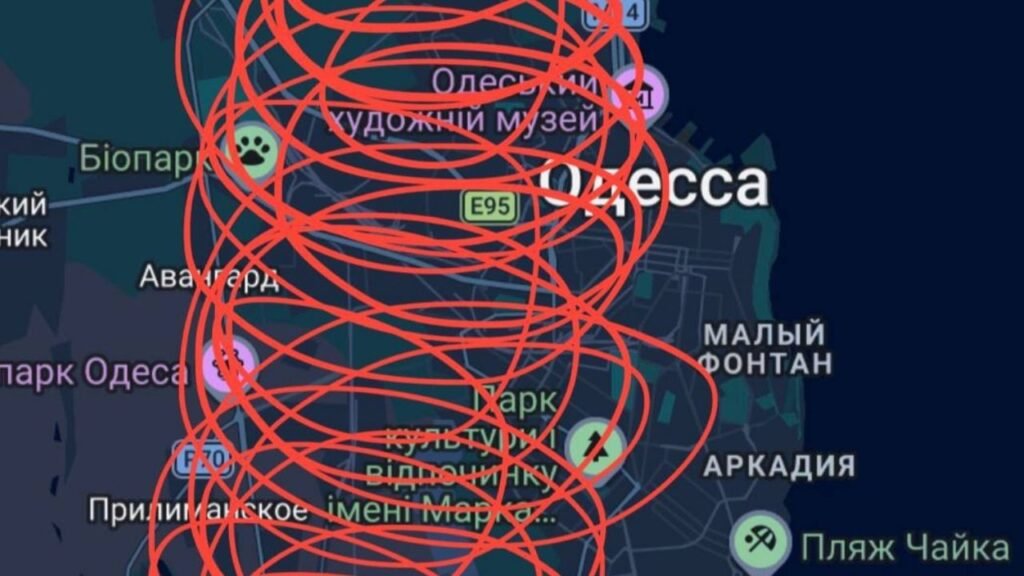
It is impossible to determine the precise mission of each drone from its flight path alone. It may be heading toward a pre-programmed target, conducting reconnaissance, provoking a response from Ukrainian air defenses, diverting their attention, or changing course because of obstacles and electronic warfare systems. At the same time, the drone’s prolonged presence over the city creates considerable psychological pressure on residents.
An air raid alert disrupts schools and restricts the operations of government institutions, shops, public transport, and other services. Residents are forced to seek shelter because it remains impossible to know until the last moment whether the drone will strike a particular target.
Nighttime flights are especially exhausting. The jet engine produces a loud and distinctive sound that can be heard across different parts of Odesa as the aircraft moves over the city. If a drone arrives after midnight and remains overhead for an hour or longer, thousands of people are effectively deprived of sleep before the next working or school day.
Russia may also launch these aircraft individually at specific intervals. Shortly after one drone completes its flight, another may appear, allowing the threat and air raid alerts to continue for much of the day. This tactic exhausts civilians, places additional strain on the warning system, and forces air defense units to remain on constant alert.
Jet-powered Shaheds differ from conventional Shahed-136 drones, which Russia calls the Geran-2. The standard drone is powered by a piston engine and typically flies at around 180 km/h. Jet-powered variants, including the Shahed-238 and Russian versions of the Geran family, can reach approximately 300–600 km/h, depending on the model.
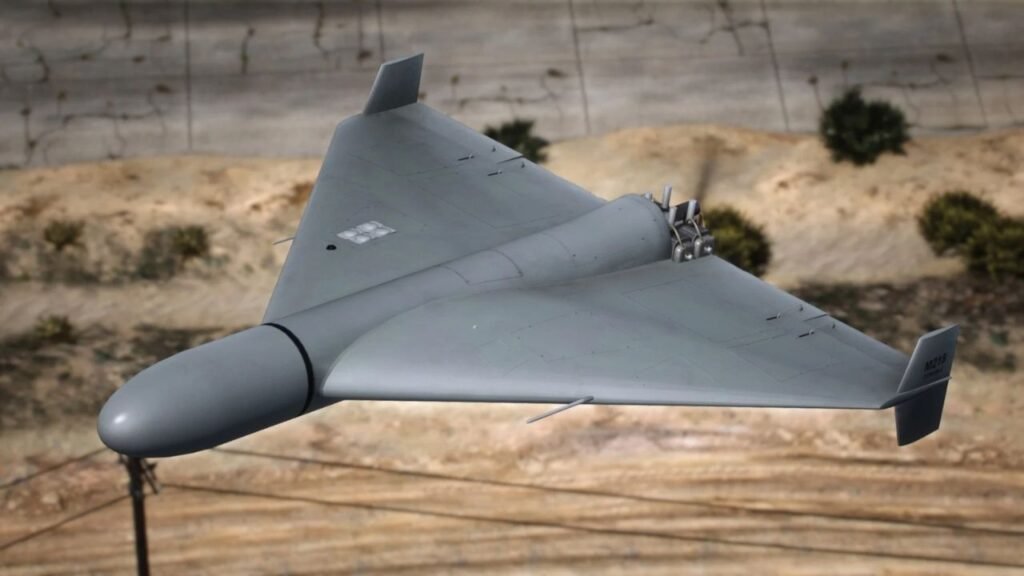
Their higher speed significantly reduces the time available to detect and intercept them. A jet-powered drone passes through a mobile air defense unit’s area of responsibility more quickly, while a conventional interceptor drone may not be fast enough to catch it.
Countering the new threat therefore requires faster interceptors, fighter aircraft, or scarce and considerably more expensive surface-to-air missiles.
Ukrainian interceptor drones have already become an effective and relatively inexpensive means of countering conventional Shaheds. However, the increasing use of jet-powered variants is forcing Ukrainian manufacturers to develop faster systems. SkyFall, for example, has developed the P1-SUN Jetkiller, a jet-powered version of its interceptor designed specifically to engage such targets.
According to Reuters, the first units have already been used against jet-powered Shaheds, while manufacturers are preparing to scale up production.
During combined attacks, Russia deploys conventional and jet-powered Shaheds alongside missiles and new S8000 Banderol miniature cruise missiles. The Banderol is often described as a missile-drone hybrid, although Ukrainian military intelligence classifies it specifically as a cruise missile.
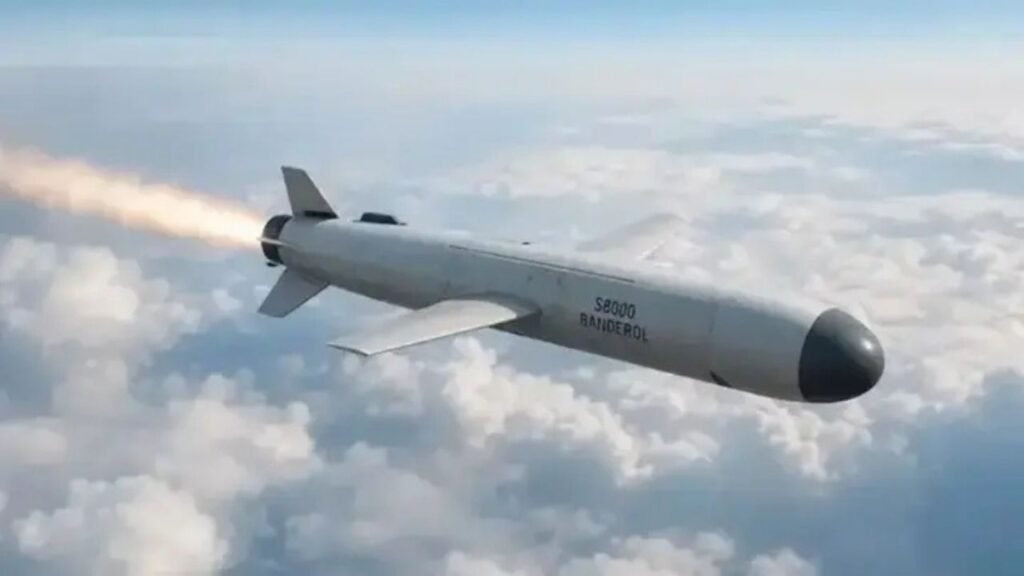
The S8000 is approximately five meters long, has a wingspan of about 2.2 meters, and a range of up to 500 kilometers. Its cruising speed is between 520 and 560 km/h, while its maximum speed reaches 620–650 km/h. The missile is carried by Russia’s Orion reconnaissance and strike drone, and it may eventually also be launched from Mi-28N helicopters.
The Banderol is equipped with a Chinese-made SW800Pro-A95 turbojet engine and a Kometa-M8 anti-jamming antenna. Foreign-made electronic components have also been found in its construction. Ukraine’s Defense Intelligence identifies the Russian company Kronstadt as the missile’s principal developer and manufacturer, according to the War&Sanctions portal.
Unlike a jet-powered Shahed, which can repeatedly alter its course and circle over a particular area, the Banderol is primarily designed to strike a designated target directly. The simultaneous use of these weapons during a large-scale attack complicates air defense operations because they have different characteristics, speeds, altitudes, and flight paths.
Russia is therefore attempting not only to strike targets but also to exhaust Ukraine’s air defense system and civilian population. For Odesa, the appearance of even a single jet-powered drone can mean a prolonged threat, disruption to the city’s daily life, and hours of psychological strain for its residents.