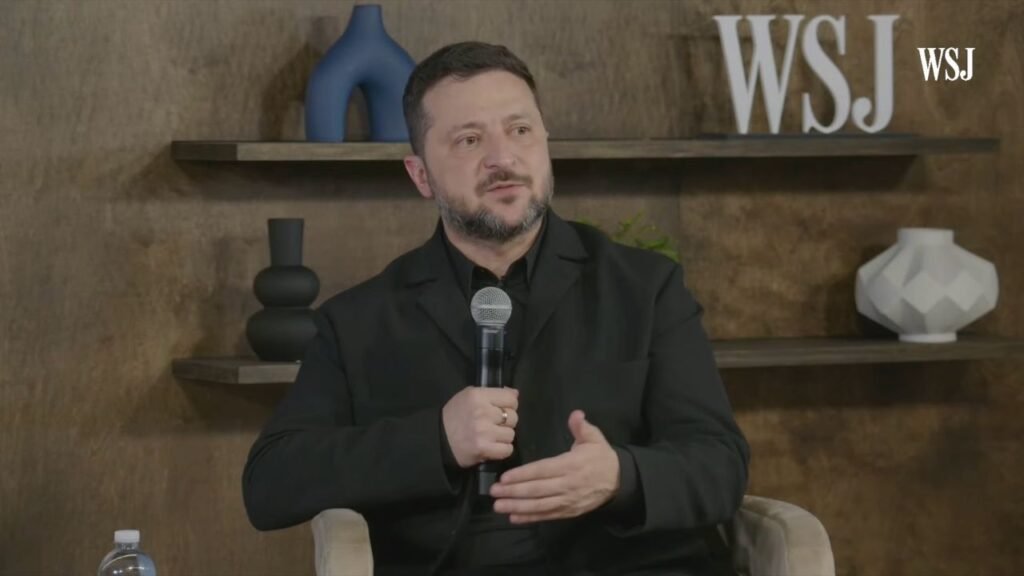
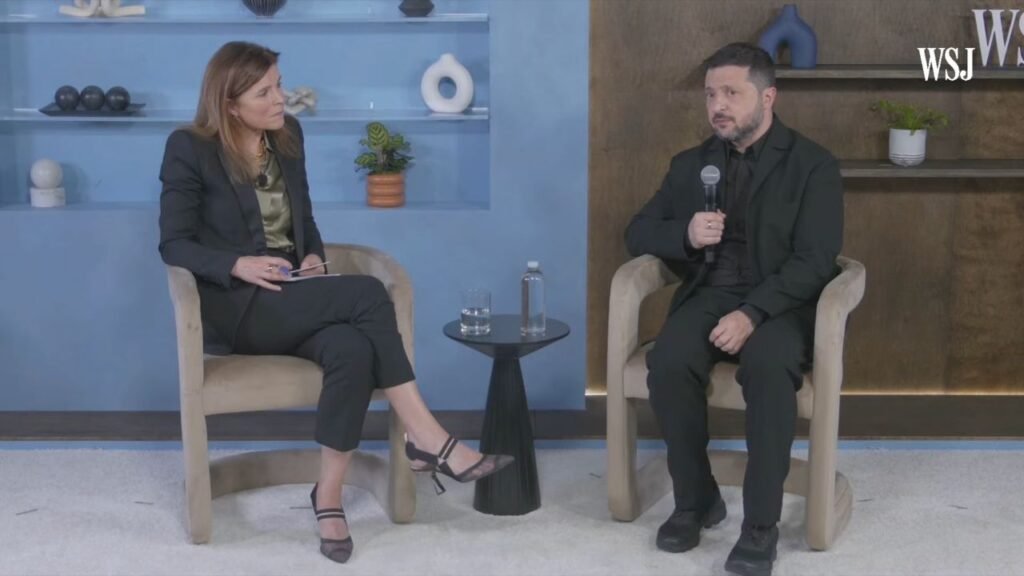
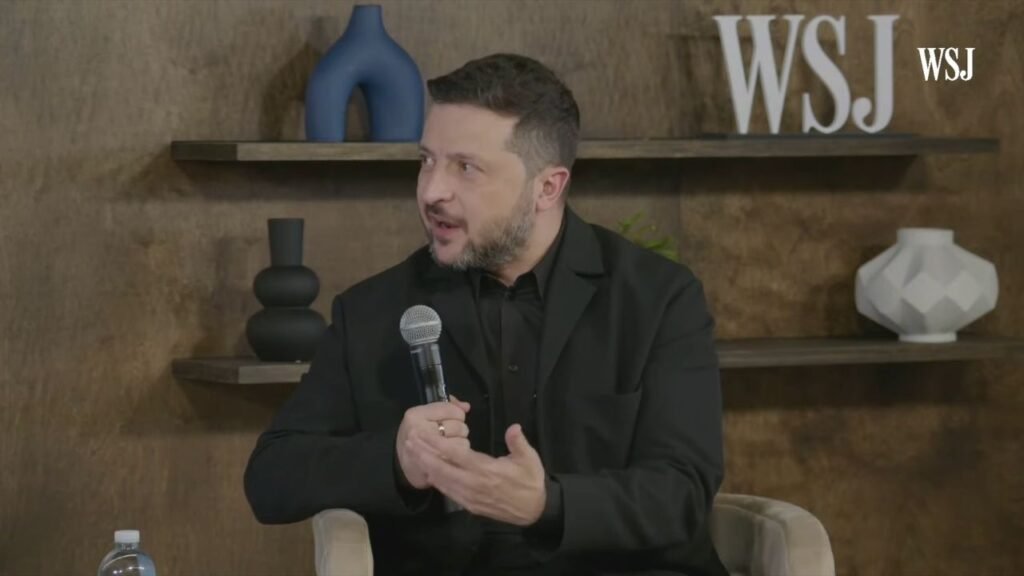
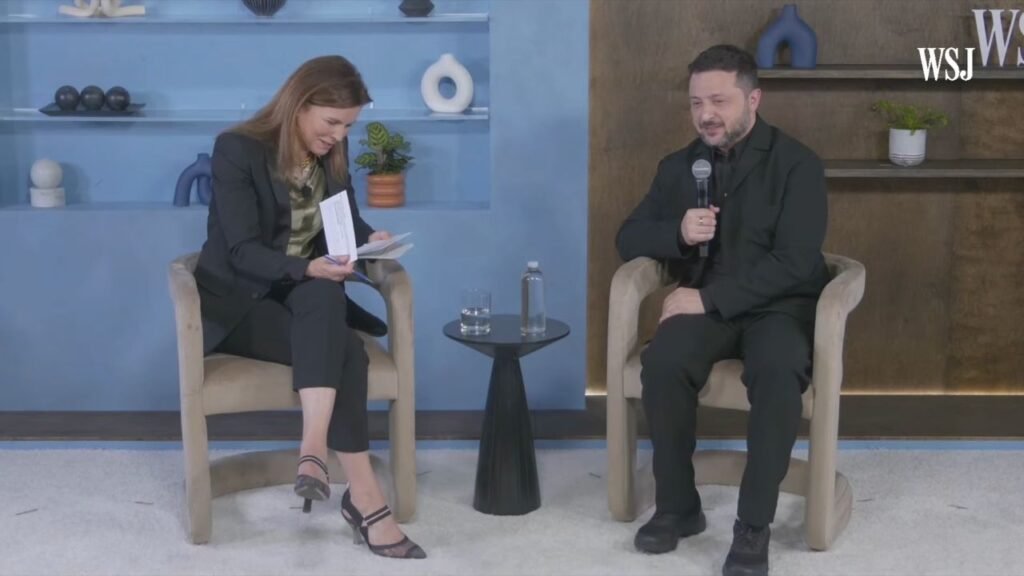
Ukrainian President Volodymyr Zelensky discussed the prospects for an energy ceasefire with Russia, his talks with U.S. President Donald Trump, Ukrainian strikes on Russian oil refineries, China’s role in the war, the situation on the battlefield and the threat Russia poses beyond Ukraine in an interview with The Wall Street Journal’s Emma Tucker.
Zelensky also spoke about Ukraine’s need for Patriot missiles ahead of winter, the development of a new Ukrainian anti-ballistic system called Freya, his contacts with Elon Musk and the personal toll of nearly five years of full-scale war. Below is the full Zelensky WSJ interview with Emma Tucker in Q&A format.
Volodymyr Zelensky: They attack our electricity. We have to respond to their painful points, to sensitive areas such as energy.
That is why our signal is this: an energy ceasefire. It does not matter what kind of energy you use or your people use. An energy ceasefire.
It is time to end the war, to show something that leads to de-escalation.
Emma Tucker: I want to talk about the prospects for an energy ceasefire in a minute, but just to go back to the Ukrainian attacks on Russian refineries: Did the president bring up the specific issue of diesel prices? Because we know this is something that is very much on his mind at the moment.
Zelensky: Today we didn’t talk about it, but by phone, yes. We really raised this topic about diesel, especially diesel.
I said: Look, maybe for somebody it is important. For us, lives are more important than the price of energy.
And, between us, it doesn’t depend on us. I will be honest: everybody understands the scale of our actions and their influence. It is not the scale of Russia.
But in any case, even if this has an influence, if everybody wants to help people with diesel or with diesel prices, okay — help us stop Putin from causing blackouts on the territory of Ukraine, from attacking our civilian infrastructure and water supplies.
Water is not an enemy of Putin. I mean, it is just water for people.
So if he attacks, he has to understand that the response will come from Ukraine. And we will definitely do it until the end, until the war ends.
Tucker: So clearly you’re not backing down. What would Russia have to do for Ukraine to stop bombing the refineries now, or to dial it down?
Zelensky: An energy ceasefire.
Tucker: An energy ceasefire?
Zelensky: Yes. I mean, it doesn’t matter what kind of energy.
If you decide not to attack energy — energy supplies, petrol, diesel, refineries, gas, water supplies, because they depend on electricity — then you don’t attack it.
If you decide not to attack critical infrastructure, it means critical infrastructure. There is a list of critical infrastructure, and I think all respected leaders of nations have to know what it means not to attack energy.
It is very clear what it means.
Tucker: So what do you think are the prospects for an energy ceasefire?
Zelensky: First of all, the problem is the elections. We see the end of the elections in Russia.
I think he was afraid that during the elections there could be some attacks or some pressure from the Ukrainian side and from the American side — attacks or drones from the Ukrainian side and political pressure from the American side.
And I think that now, for him, there are no big challenges. Now he is not thinking about his society.
That is why the prospect is to return again to the bipartisan vote, the Lindsey Graham bill. It opens the possibility for the president to really implement sanctions.
Tucker: Did you discuss that with the president today?
Zelensky: Yes, we spoke about sanctions.
Tucker: Did he say he was going to implement the package?
Zelensky: I think he will try to negotiate some kind of energy ceasefire, something like this. And if not, I hope he will take stronger steps to push Putin.
Otherwise, Putin will not stop.
I think only pressure — political pressure and sanctions, which are very influential on him — can work.
And there are also the internal problems of ordinary people. I don’t mean the people around him. They are from another world.
I mean ordinary people, ordinary society, with a deficit of energy, a deficit of petrol, a deficit of diesel, money and so on.
These are the things he is afraid of.
Tucker: Putin talks a lot about Russia’s successes on the battlefield, but we also hear that his generals aren’t telling him the truth. Do you have any insight as to whether Putin genuinely doesn’t know the truth about the state of play, or does he know and talk about the wins in order to convince the West and his own people that Russia is winning?
Zelensky: First of all, the situation on the battlefield is not successful for Putin. He is not winning. It’s true.
And he is not losing. It’s also true, because for him human losses do not mean losing.
For Ukraine, it means losing, because you lose people. When you lose people, it means that you lose in the war, because at the end of the day all of this is about humanity.
He is not winning because on the battlefield almost everything is frozen. I mean, it is moving a little bit.
For example, this year he occupied about 890 square kilometers, and we de-occupied 800 in different directions.
It means that he will have 90 additional — okay, let’s say 100 additional — square kilometers for the year.
It is many times less than before, when they occupied about 3,000 to 4,000 square kilometers per year. Now it is 100.
And he lost 270,000 people — dead or seriously wounded. I mean those who will not come back to the front. Around 260,000 already.
So you can understand the price of 100 square kilometers. It is a very high price.
He is not winning and he is not losing, but his society is losing people and money. And 100 square kilometers is nothing compared with this. It is a very high price.
The problem is his generals. As you said, they share information with him, and I don’t know whether he doesn’t want to know the details or whether he knows the details and then shares something different with the Americans, for example with the president’s team.
I don’t know what the difference is, but it doesn’t matter.
Today he doesn’t feel that he has to stop.
This is the problem.
Tucker: How are you preparing? Clearly then you’re in for a long winter. Is Ukraine ready for what comes next over this winter, which is likely to be a difficult and challenging one for you to get through?
Zelensky: This entire period of the war is a period of survival for our nation.
In any case, it is not a normal life. We cannot just close our eyes and say that it is normality, a “new normality.” No.
It is not a normal life.
That is why, of course, you have to prepare.
I hope we have a chance to stop and end this war before winter, if…
There are several “ifs.”
The first “if” is always the will — the will of the United States, especially the president, the political will to end it.
I mean, he has the political will to end it. But with Putin, the will is not enough. With Putin, you need pressure.
The second is technologies.
We need some technologies from the United States. We have our experience and we are always ready to exchange it, but we need something from the United States.
We need a winter package: missiles for Patriot systems.
Only the United States produces them now. Yes, Germany is doing a little bit and they are on the way, they have licenses.
And, by the way, we are very thankful to the American government because they reacted positively and said they will give them.
But again: “they will.”
We need them now, without “will.” Without this grammar rule.
It is important, very important, to have everything now.
If you want to end the war now, you need to react now. Otherwise, it can be too late.
As for getting through winter, we have our technologies. We will be ready.
President Trump will support packages of missiles. It is up to some partners — not too many partners, as I said.
And, of course, tomorrow you will see… I wanted to say “wait,” and then I understood that maybe you don’t have to wait.
I’m speaking about China.
Tucker: So you will host the Chinese leader in Washington?
Zelensky: Yes, tomorrow.
And I think that if China decides — in the fifth year of the full-scale war, at the end of the fifth year — to react to Russia, I think we can also have a chance.
Tucker: Tell us a bit more about that. How do you think China could contribute to bringing an end to the war?
Zelensky: Russia is blocked. Its economy is based on relations with India, sometimes Turkey, and China.
And, of course, if these countries stop — I mean, if this trade stops, if they stop buying energy — it is understandable that Russia will stop this war.
It will stop the war extremely quickly if the United States applies the pressure it can, if China applies the pressure it should — between us, the pressure it should have applied already — and India does the same.
That is enough to stop them.
They will not have enough money.
They spend about $340 billion a year on this war. $340 billion. It is a huge amount.
How can they get this money if we respond to their attacks on our energy by responding against refineries?
They don’t have enough diesel. We destroyed 45% of their facilities. Forty-five percent.
And the second part is exports. They get money from exports. If they cannot export until they stop the war, they will not have enough money to pay their soldiers.
They already have 1.5 million, and now they want additional mobilization.
This is the answer: Do they have money? They do.
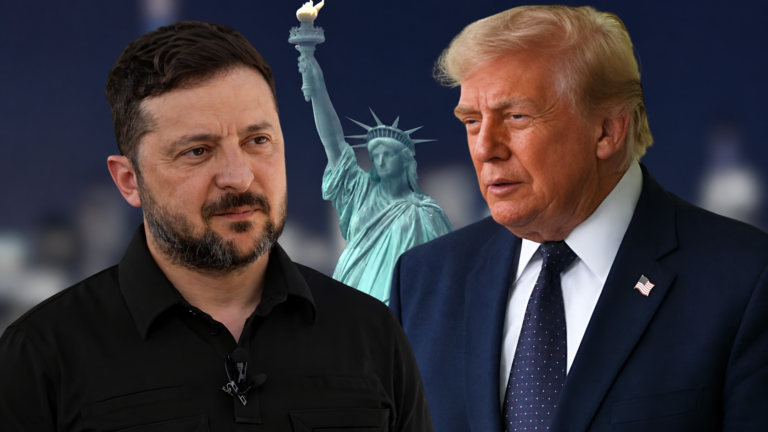
Tucker: Did you get a sense from the conversation you had with President Trump earlier as to what the American plan now is to end the war in Ukraine? The Anchorage proposal hasn’t gone anywhere. Do you know now where President Trump’s head is on this?
Zelensky: President Trump’s idea is to mediate and put Putin and me at the negotiating table.
It is not simple.
It is not simple because one of us is not ready. That is the first thing.
The second is to find some solution. And when you want a solution, you want to find some compromises.
Again, it is not simple because one of us is not ready for compromises. Not now.
But Russia already has a deficit of $126 billion or $130 billion for this year. They already have this deficit, and it will increase. They will have problems.
The problem for us is waiting, going through winter, surviving and losing so many people.
Time costs us. The price is very high.
We can stop this war.
I think Putin told President Trump that he needs our territory and that he wants us to leave our territory.
And this is the problem for us.
How can we do that?
We didn’t do it on the first day of the war.
Our people have been strong. Our children have been strong. They are tired, I think, very tired. It is a long war. But they are strong.
We didn’t do it on the first day of the war.
So after all these days of surviving, to simply sell our independence and sell our freedom — I think it is not about us.
Tucker: Do you think Putin has ambitions beyond Ukraine? And if he does, are the other NATO countries ready for some sort of attack on European territory?
Zelensky: Look, he needs a victory. Some victory, even if it is not a real victory.
He has to sell something to his society.
As I said, he is afraid of his society. That is why he needs to sell something.
And what can he sell?
Ukraine is not a victory. Everybody understands it. And I think even though he is not a young guy, he understands that he does not have enough time to occupy us.
He does not have enough time.
That is why he will try to find another target for this marketing — sorry that I use such a word — for this bloody marketing, to sell some victory to his country, to his society.
What does changing the target mean?
If we stay strong, he will change the target.
What target?
Of course, not such a big country, because he understands the challenges of attacking a big country like ours.
He will try to find some small country, but one that he can sell as a big victory.
Tucker: Which country might you be thinking of?
Zelensky: Closer to him.
Some of them are NATO countries. Better for him if they are NATO countries, to show that NATO is not so strong.
He has already shown it, by the way.
He crossed borders — air borders.
It is understandable that it was not on land, but he already used drones.
Moldova is not in NATO, but it is an independent country.
Moldova, Romania, Poland. Airports in Nordic countries. Leipzig in Germany.
He has already done it many times.
But sometimes I think that in NATO we want to close our eyes and think that we are safe.
No. We are not safe.
Tucker: So do you think NATO should be doing more to repel these drone attacks?
Zelensky: Of course. To respond.
It is not only about the attacks. It is about responding.
How?
Bring him in, speak, say: “This is the last time.” Show Article 5.
Show it not even to Putin, but to your societies, to your countries. Show that their leaders are strong leaders and their countries are strong countries.
Don’t be afraid. Speak.
Putin has to understand that there are 30 countries already. God bless, maybe 34 someday. But it doesn’t matter.
Thirty countries is a lot.
A huge number of huge economies, strong and smart people.
Don’t be afraid of one person.
Tucker: I want to ask you about another meeting you had recently, and that was with John Ratcliffe, the CIA director, who you saw when you were in Ireland, I believe.
Zelensky: It’s a secret.
Tucker: It’s a secret? Damn. You can’t tell me anything?
Zelensky: He told me it’s a secret.
No, no, he didn’t tell me.
Tucker: But has he got a role now in ongoing negotiations?
Zelensky: Nope.
We decided that we would not share that we had a meeting.
Tucker: It’s too late. The cat’s out of the bag.
Zelensky: But we decided.
Tucker: That’s a very good answer.
Zelensky: Sorry. I’m so sorry.
But he’s looking good. He’s looking good.
Sorry, sorry.
Tucker: Are you going to see him again while you’re here?
Zelensky: It’s a secret.
I’m sorry, I can’t.
Tucker: Who else would you like to see while you are here? We were chatting earlier and you mentioned that you would like to have a meeting with Elon Musk. Can you tell us what you would be sitting down to discuss with him?
Zelensky: No.
First of all, we are thankful to his company, to SpaceX, and to Elon.
We really had good connectivity for our people during these challenges, during the war, with Starlink.
It is important. Very important.
The problem is that China is very close to such technologies, and they will share them with Russia.
It is true. They have begun to do it.
There have already been several cases when they tried to use this new technology. Not massively, but they are on the way. They are training. They are testing it in practice.
They use it, for example, with the window of a house.
The drone comes through the window, hovers and waits for people, and then attacks when people come.
Between us, the United States of America really has such technologies.
China will share them with Russia — it has already shared some.
We think that at the end of December or in January they will share these technologies, and this is a fact.
That is why I wanted to speak — I mean, not “wanted.” I spoke with Elon. Our teams have to speak about it.
I think it is important.
Why are North Koreans using technologies and learning in Ukraine?
Why will 40,000 or 50,000 — already 50,000 this year — North Korean soldiers come to this war?
For what?
To help the Russians? I’m not sure.
First of all, to get experience. To prepare drone operators, to learn new technologies and a new way of warfare — an absolutely new way.
And then what will they do?
Where will they use it?
They will use it in territories where they have their interests.
That is why I think China is using its technologies with Russia not because they are great friends, brothers and sisters.
Of course not.
Everything is very pragmatic, because they will need this experience somewhere.
That is why I always say that during this war — this too-long war, with all these military technologies — we have to understand that there is no distance in this war at all.
None.
You see that Iranians can already use missiles with a range of 5,000 kilometers.
We use drones, missiles and jet-powered drones with ranges of 3,000 to 3,500 kilometers.
The Russians are also on the way to around 3,000 kilometers.
And I know that the goal of the Russians and the Iranians is to use drones massively at ranges from three to ten thousand kilometers.
So what does that mean?
Where is the distance in this war?
There is no distance.
That is why we need to share technologies. We need to share help. We need to share support.
We have to stop any kind of terrorism, any kind of aggressor.
We have to stop them.
Tucker: Tell me a bit about your own ballistic and anti-ballistic programs that you’re developing. What’s the state of play with these programs?
Zelensky: Today we know that one of the best systems in the world is the Patriot system.
The United States has it, and not only the United States. Some Asian partners have it and, as I said, there are some licenses in Europe.
On this track, we want to have licenses in the future.
But in parallel, Patriot is great, but it is very expensive and there are not enough systems.
Not enough for Europe and, between us, not enough for the world.
Production is so small. Even with the increases that I know the American government has provided, and production will increase, it is not enough.
And it will never be enough.
Understanding what this war means, we wanted to create an anti-ballistic system with cheap missiles, using our experience, and give licenses to other countries.
To give them the possibility to save themselves.
Not even for wartime — for peacetime, so their societies can be sure about tomorrow, can be calm and know that their shield is closed.
That is what I wanted to create and share, because it is so difficult to get even one missile.
That is why I wanted us to create thousands and millions of these missiles, simply to give people what they need, because I am sure they need them just to have them.
That is why we began to work on it.
And we think that in winter, at the end of this year or the beginning of next year, we will have — we hope — the first system to test and see how it works.
The name of the system is Freya.
God bless it will work.
No — God bless it will not have to work, because we will have peace.
Tucker: We haven’t got much time left, so I’ve got a couple more questions. One of them is very specific. I want to go back to the meeting you had with President Trump today. Did he ask you to withdraw your support for the International Criminal Court?
Zelensky: No.
Tucker: Has he asked you to?
Zelensky: Never.
Tucker: About the International Criminal Court?
Zelensky: No. We never spoke about it.
Really.
Maybe I was sleeping during that period of time.
Tucker: That would be understandable.
Zelensky: Or maybe we talked about this part in Ireland.
Maybe?
Ah, you didn’t know.
It was a joke.
Tucker: You should be careful. There are a lot of journalists in this room.
My last question for you is about you.
Very soon this war is going to have been going on for five years. I interviewed you, I think, three or four years ago, and even then you had been at it for two years.
I asked you: How do you deal with the stress?
And you talked to me about helping your son with his homework.
Zelensky: I still have a small son.
Tucker: Do you still help him with his homework?
Zelensky: He’s not so small.
This is the problem with all these challenges: time, people’s lives when they are shortened because of the war, the people we lose, and time.
Yes, this is the big problem.
Tucker: So how do you deal with the stress yourself now?
Zelensky: I don’t know.
I’m not sure that I really deal with it.
What we do is try.
We try to do our job in a way where it is not even about whether people will respect you.
It is about being able, after the war and after this presidential job, to continue living in your country, walking through the streets, and nobody wanting to kill you or hate you just because you were a piece of shit, not a leader and not a man.
I mean, this is what you do. It is the way you live and the way you try to live.
Sometimes with all my mistakes and so on.
During the war, you make so many mistakes.
Why?
Because you have to — as President Trump says — make a deal.
So you have to make hundreds of deals per day. Uncomfortable ones. Very sensitive ones.
Sometimes you don’t even want to do it, but you have to.
There are a lot of things.
And that is why it is all about your attitude to your job, your country and your people.
At the end of the day, everything is about people.
People give you energy to live.
And there are also people whom you hate, and they take all your energy.
That is what it is all about.
So I try to live for good people.
I hope there are a lot of good people around us.