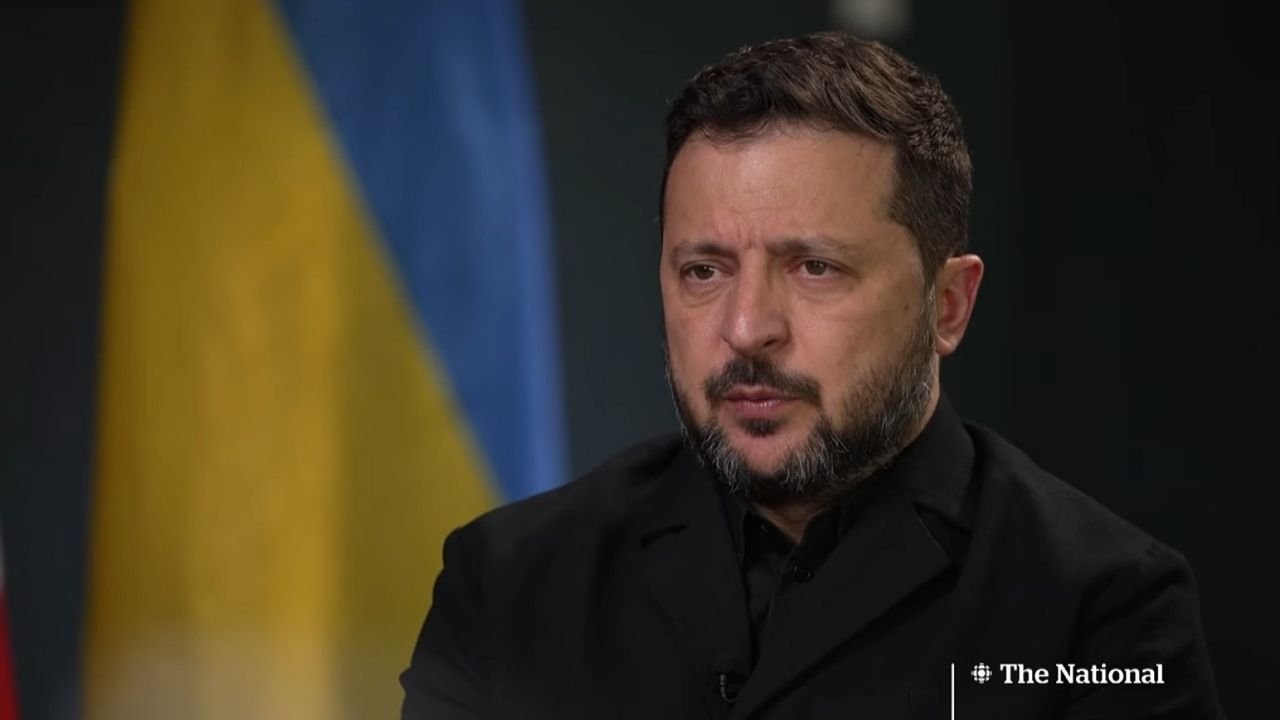
President Volodymyr Zelensky said Ukraine was ready for an unconditional ceasefire followed by negotiations with Russia. He made the remarks in an interview with CBC’s News: The National.
“We are ready. We discussed whether the Russians are ready for a ceasefire. Yes, without any conditions — simply cease fire and start talking. If, after a certain period, they do not like something, fine, that is their decision. But if they simply want to keep fighting, that is a bad idea. We need to stop the war without further losses and move toward diplomacy,” Zelensky said.
Commenting on Jared Kushner’s remarks about seeking a win-win solution for Ukraine and Russia, the president stressed that, after the enormous loss of life caused by the war, there could be no outcome in which both sides emerge as winners.
“To be honest, there is no win-win in this war. There cannot be one because of the scale of the human losses. The possibility of such an outcome disappeared on the very first day of the war. The most important victory — not only for Ukraine or Russia, but for the entire world — would be peace and an end to this war. It would be a victory for human life,” he said.
According to Zelensky, US representatives have gradually begun to understand Ukraine’s position better. He also welcomed the visit to Kyiv by US special envoy Steve Witkoff and Jared Kushner following their numerous trips to Moscow.
“I am glad they came to Kyiv after visiting Moscow six or seven times. It was important. They had to demonstrate respect for our people — and they did,” the president said.
Zelensky added that the US side had asked Kyiv not to make some of the proposals public before discussing them in detail and providing its response. Ukraine, he said, is preparing for a meeting with US President Donald Trump in New York.
Addressing the Kremlin’s territorial demands, Zelensky rejected the idea that Vladimir Putin allegedly wants only a certain portion of Ukrainian territory.
“The problem is that we have to change Putin’s mind. He is the biggest terrorist in the world. Does he need a few kilometres? What for? It is very strange to hear some partners say: ‘Look, he only needs this part of Ukraine, only these kilometres — and that is all.’ No, that is a crazy idea. He does not need kilometres. He needs Ukraine. He wants Ukraine to become part of Russia,” the president stressed.
Zelensky said he was prepared to meet Putin in person if such talks could help bring peace closer.
“It is not my wish, and it would certainly not be the best day of my life. I would rather spend it with my family. Putin is an enemy. What does it mean to sit at the same table as an enemy? I am ready to do it for the sake of a result that could bring us closer to peace,” he explained.
At the same time, the president warned that Putin’s strategic objective had not changed and never would.
“I know his true goal. This man wants to occupy all of Ukraine. And he will do it if we are not strong enough, if the world grows tired, or if I do not have security guarantees. Security guarantees mean that I should not have to fear that he will occupy us tomorrow. Because he will not change his goal. Never,” Zelensky said.
Asked whether he trusted Witkoff and Kushner, the president suggested that many people in the West were drawn to the prospect of engaging with political leaders who had wielded immense power for decades.
“People always want to be closer to those who possess enormous power and have remained in office for 30, 40 or 50 years. He is almost dead, but he is still in power — and for some people, that means a great deal. This is not only about Jared or Steve. Many Americans and Europeans want to engage in dialogue with Putin because they see him as the richest and most powerful,” Zelensky said.
He stressed that Ukraine had secured its independence and that Kyiv and Washington therefore needed to trust each other.
“America must defend democracies when a democracy asks for help. This is about the world order and normal rules. Major powers must protect smaller nations,” the president said.
Zelensky believes that Witkoff and Kushner genuinely want to end the war, but that their primary objective is to achieve an outcome aligned with the current interests of the United States.
“They want to end the war in a way that satisfies today’s United States — as quickly as possible. We also want to end it as quickly as possible, but not in a way that leaves only one side paying the price,” he stressed.
During the interview, Zelensky also discussed the 100-year strategic partnership agreement between Ukraine and Canada. According to him, it is less about a specific period of time than about the historical roots of the relationship between the two countries.
“Millions of Ukrainians live in Canada, and many of them arrived here around a hundred years ago. That makes it highly symbolic. The agreement means that we will remain together for a long time — our children and grandchildren will work together. We will share our experience in security, energy, food security and many other areas,” the president explained.
Speaking about tensions between Canada and the United States, Zelensky described the situation as strange and dangerous. He noted that being neighbours did not in itself guarantee friendly relations, citing Ukraine and Russia as an example.
“People may know each other, consider themselves friends for a long time and live as neighbours. But at the same time, they must protect their borders and build a strategic partnership. On the one hand, neighbours can be friends; on the other, they can become enemies, as happened in our relationship with Russia,” Zelensky said.
The president expressed hope that the United States and Canada would restore constructive dialogue, as he believed there was no alternative. At the same time, he acknowledged that tensions between the allies and developments in the Middle East could lead to declining attention and support for Ukraine.