
Kyiv is experiencing serious public transport problems amid prolonged air raid alerts and the aftermath of a massive Russian attack. Long queues have formed at stops across the capital, while overcrowded buses and trolleybuses are not always able to pick up all passengers.
Photos and videos circulating on social media show dozens of people trying to board public transport. The situation remains particularly difficult on routes connecting the right and left banks of the capital. Restrictions on metro services along above-ground sections have forced a significant share of passengers to switch to surface transport.
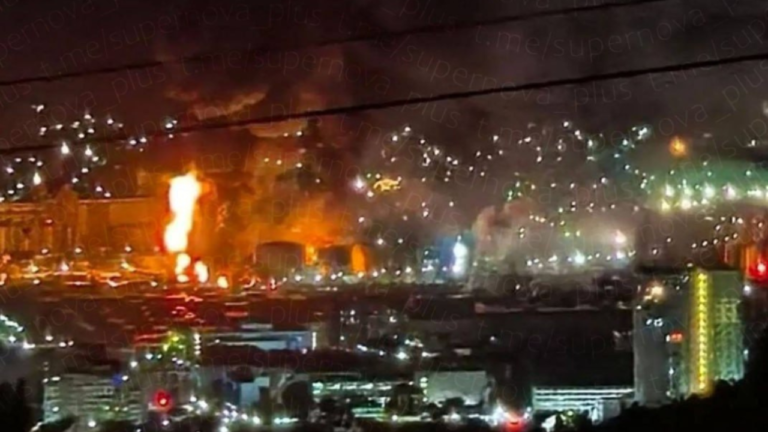
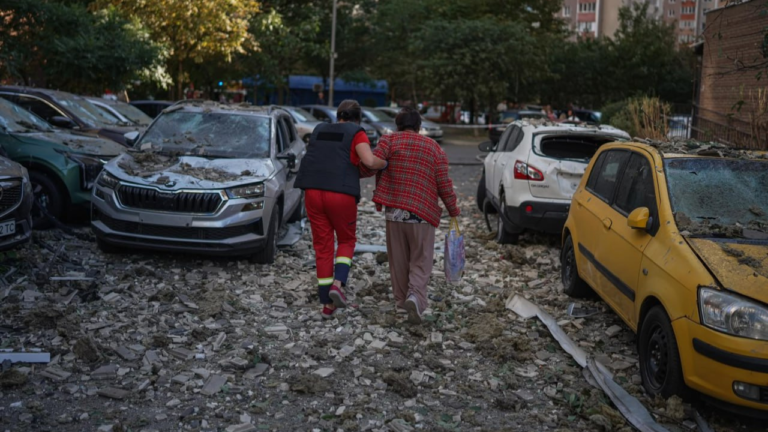
The situation was further aggravated by the Russian attack overnight into September 8. According to Kyiv city authorities, two people were killed and ten others injured in the capital. Falling debris and fires were reported in the Holosiivskyi, Darnytskyi, Podilskyi, Solomianskyi and Shevchenkivskyi districts.
Several public transport routes were operating with changes due to road closures and the work of emergency services.
This is not the first time Kyiv has faced major transport problems. The previous day, September 7, Prime Minister Serhii Koretskyi held an emergency meeting with government officials and representatives of the capital’s authorities.
According to the Cabinet of Ministers, following the meeting, the prime minister ordered that the Kyiv Metro immediately begin operating properly in accordance with decisions adopted by the government.
Koretskyi said traffic congestion, queues and crowds at public transport stops were not only inconvenient but also posed an additional danger during aerial attacks.
“Decisions must be implemented! They must be implemented quickly and with due consideration for the current situation in the city. I expect an immediate response from the city authorities,” the prime minister said.
He stressed that there were no grounds for delaying the introduction of the metro’s new operating procedures. The changes are primarily intended to maintain transport links between the two banks of the Dnipro during prolonged air raid alerts.
The Kyiv Defence Council has already approved new rules for the operation of municipal services. Most of the changes will take effect at midnight on September 10.
Under the decision published by the city authorities, public transport services will depend on the level of aerial threat.
During a yellow-level alert, which will mainly be declared in response to the threat of attack drones, the Syretsko-Pecherska, or Green, metro line is expected to operate without restrictions. Trains will carry passengers across the Pivdennyi Bridge in both directions.
During a red-level alert, associated with an increased threat of a missile or combined attack, the Green Line will be divided into two operating sections: Syrets–Vydubychi and Slavutych–Chervonyi Khutir.
The Sviatoshynsko-Brovarska, or Red, Line will continue to operate under restrictions during air raid alerts. Trains will carry passengers only along the underground section between Akademmistechko and Arsenalna stations.
To partially compensate for the restrictions, the city has launched an additional No. 1-M bus service. It runs from Palats Sportu metro station through Arsenalna to Lisova station. However, the Kyiv City State Administration has stressed that the route cannot fully replace the Red Line’s above-ground section.
On September 9, the Kyiv Metro will test train operations along the Green Line’s above-ground section during a yellow-level alert.
The municipal company said the test was needed to assess new safety procedures and coordinate the actions of train drivers, dispatchers and station staff.
Employees must practise the transition from yellow to red threat levels, passenger notification procedures and the possible evacuation of people from the above-ground section. Automated audio announcements are also being updated in 105 lead carriages operating on the Green Line.
If the testing is successful, Green Line trains will be allowed to carry passengers across the Pivdennyi Bridge during yellow-level alerts beginning on September 10.
The new rules also include changes to traffic across road bridges spanning the Dnipro.
Traffic across the Pivdennyi Bridge will be permitted during air raid alerts without
permanent restrictions. However, the bridge will be temporarily closed for 30 minutes after an alert is declared and for another 30 minutes after the all-clear. Access to the bridge from Saperno-Slobidska Street and Mykhaila Boichuka Street will be closed during alerts.
The Podilsko-Voskresenskyi Bridge will operate under a similar system, but with reversible traffic. No changes are planned for the Darnytskyi and Pivnichnyi bridges, the Paton Bridge or the Metro Bridge.
Under the Kyiv Defence Council’s latest decision, surface public transport should continue operating without restrictions. However, traffic congestion, road closures, infrastructure damage and a sharp increase in passenger numbers following the suspension of above-ground metro services could continue to cause significant delays.
Kyiv’s curfew will also be shortened by one hour from September 10. It will run from 1:00 a.m. until 5:00 a.m., instead of the previous midnight-to-5:00 a.m. schedule.
Public transport services will consequently be extended by one hour. The city also plans to arrange four bus routes to carry passengers from Kyiv Central Railway Station during curfew, as air raid alerts frequently cause trains to arrive in the capital late.
The operating hours of restaurants, entertainment venues and shopping malls are not expected to change for now.
The measures are intended to reduce pressure on surface transport and prevent large crowds from gathering at exposed stops. However, the situation on September 8 showed that until the new procedures are fully introduced, the capital’s transport system will remain vulnerable to prolonged alerts, attacks and the simultaneous closure of several important routes.