
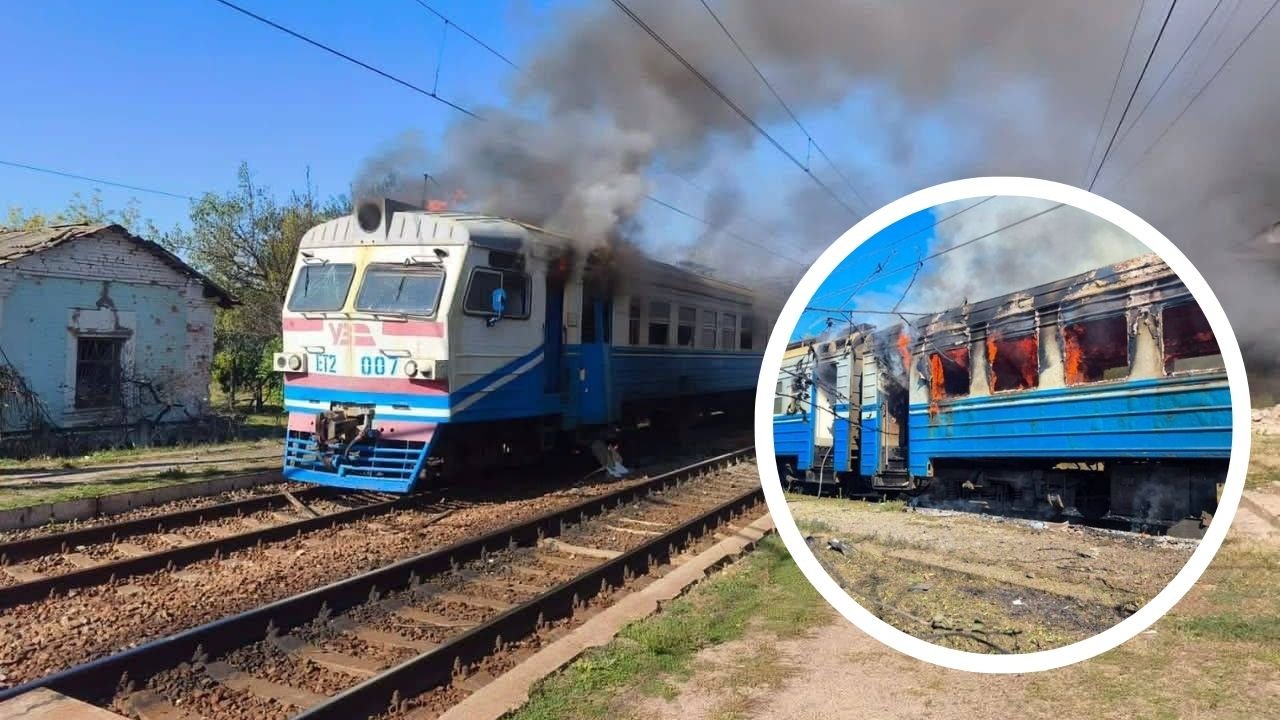
One person was killed and eight others were injured in a Russian strike on a commuter electric train in the Kharkiv region on September 18. Russian forces attacked a railway station in the Nova Vodolaha community of the Kharkiv district with jet-powered drones. The strike sparked a fire in two carriages of the commuter train, which rescuers later extinguished.
The attack was the latest in a series of strikes on Ukrainian passenger trains that have become particularly frequent in recent weeks.
On September 13, a Russian drone struck the locomotive of the Kyiv–Warsaw passenger train near the Yahodyn station in the Volyn region, close to the Polish border. The threat was detected in advance, allowing passengers to be evacuated. No one was injured.
Shortly before the attack, a diplomatic train carrying Western officials and politicians, including former British Prime Minister Boris Johnson, had also passed through this section of the railway.
On September 9, a Russian Shahed drone struck the rear of a Kharkiv–Izium train at a railway station near the village of Iskra in the Kharkiv region. A fire broke out following the strike. The number of people injured later rose to eight, including passengers and railway workers. One of the injured was in serious condition.
The train had been stopped for evacuation after the threat was detected.
On September 8, several passenger trains came under Russian attack.
In the Sumy region, drones attacked a Kyiv–Sumy train. Around 90 passengers were evacuated in advance, and no one was injured. The same day, Russian forces attacked a commuter diesel train in the Sumy region. That train was also stopped, but not all passengers managed to move to a safe distance in time, and several people suffered shrapnel wounds.
Another strike targeted a Dnipro–Zaporizhzhia regional train. Passengers were evacuated to a shelter after a warning about the threat, but a train attendant who returned to the train after the evacuation order was killed.
On August 23, a jet-powered Shahed drone struck the locomotive of passenger train No. 147, traveling from Zhytomyr to Odesa, in the Odesa region. There were 593 passengers on board, including 15 children. Ukrzaliznytsia’s monitoring team detected the threat, the train was urgently stopped, and passengers and railway workers were evacuated before the strike. No one was injured.
One of the deadliest attacks in recent months was a jet-powered drone strike on a passenger train in the Odesa region on August 13.
The drone struck the locomotive, killing the train driver and his assistant. There were 340 passengers on board, including 67 children. After detecting the drone, the locomotive crew attempted to move the train to a location where passengers could be safely evacuated, but they did not have time to leave the locomotive themselves. None of the passengers were injured.
Thus, in just over a month, a series of direct attacks on passenger and commuter trains has been recorded in the Odesa, Sumy, Zaporizhzhia, Kharkiv and Volyn regions.
According to Politico, as cited by Ukrainian media on September 18, the intensity of attacks on Ukrainian rolling stock has increased significantly. Ukrzaliznytsia is now losing between 37 and 40 locomotives a month as a result of Russian attacks. Since the beginning of the full-scale invasion, more than 500 locomotives have reportedly been damaged or destroyed.
Ukrzaliznytsia CEO Oleksandr Pertsovskyi has said the company views the attacks as an attempt, among other things, to isolate frontline communities, spread fear among the population and disrupt the Ukrainian economy.