
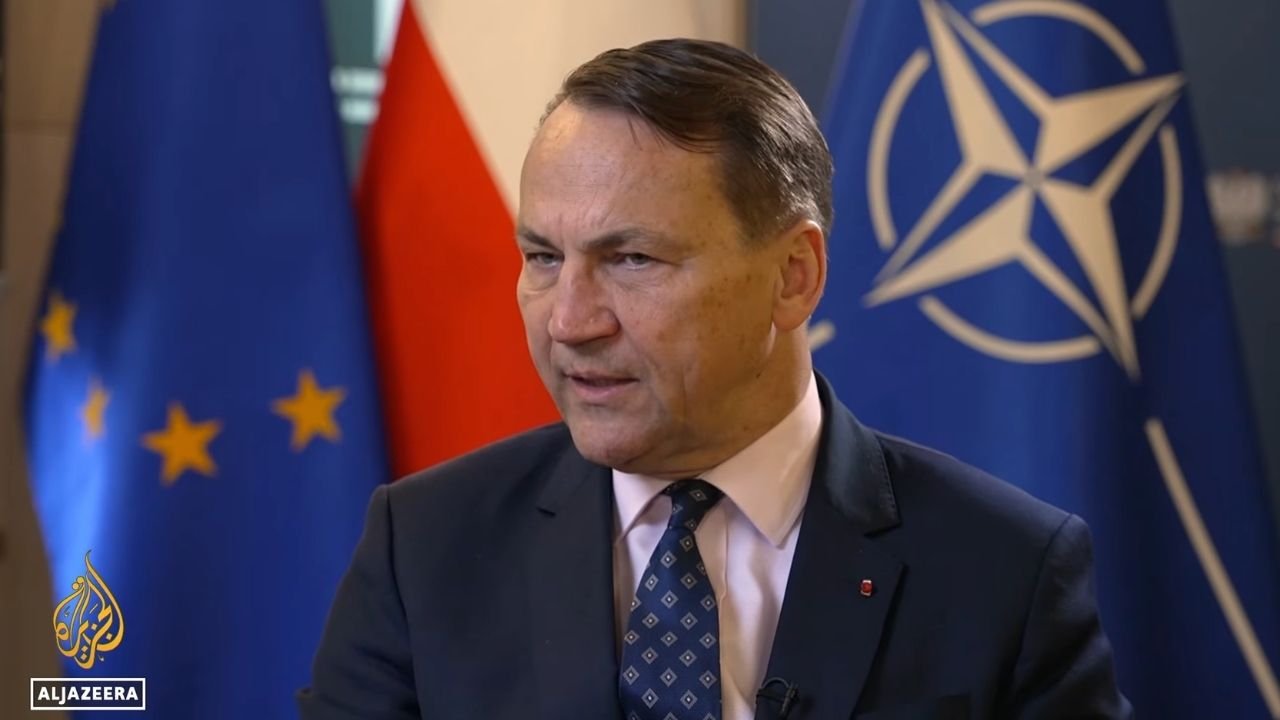
Polish Foreign Minister Radosław Sikorski has said that the United States has not financed Ukraine’s defense for more than a year and a half, while Donald Trump’s administration continues to increase pressure on Kyiv. He argued that ending the war ultimately depends on Vladimir Putin recognizing that a military victory is unattainable.
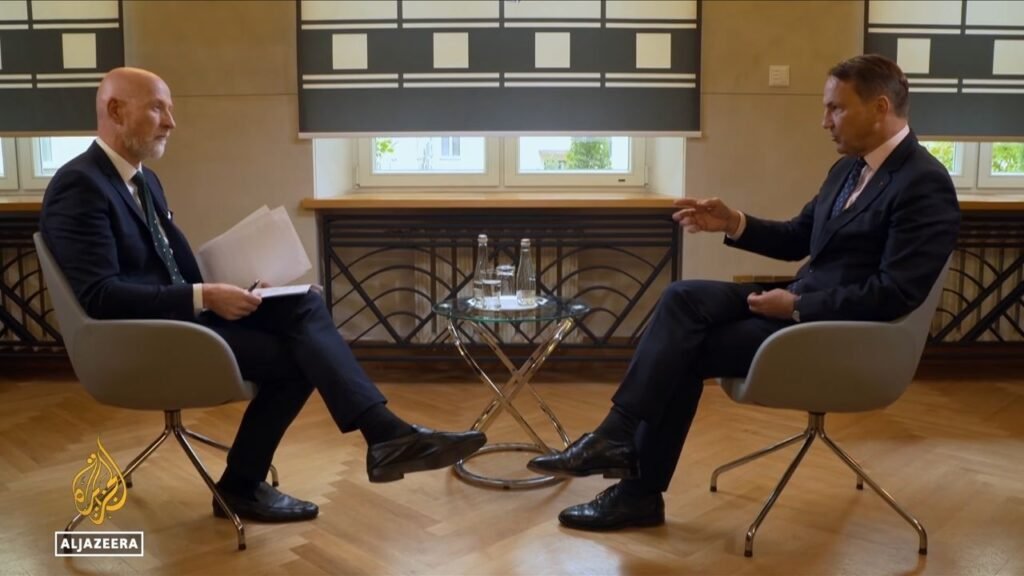
Speaking in an interview with Al Jazeera, Sikorski discussed US pressure on Ukraine, a potential energy ceasefire, Russia’s economic difficulties, Western sanctions and the prospects for peace negotiations.
The US no longer funds Ukraine but continues to exert pressure
Asked about reports that Washington could restrict Ukraine’s access to a mechanism for purchasing American weapons, Sikorski emphasized that Europe has effectively taken responsibility for financing Ukraine’s defense.
“Remember that the U.S. no longer finances this war since January of last year. In other words, for more than a year and a half, the United States has not contributed a single cent to the defense of Ukraine or to the sustaining of the Ukrainian state. We are doing it, Europe,” Sikorski said.
He explained that the NATO mechanism for purchasing American weapons is funded by European countries, including Poland.
Sikorski acknowledged that certain types of American military equipment remain essential for Ukraine, particularly PAC-3 interceptors used by Patriot air defense systems, which are currently in short supply.
However, he suggested that if Washington restricts intelligence sharing, Ukraine may have to rely on alternative sources of information.
An energy ceasefire cannot cover only Russian oil refineries
Another major topic was Washington’s pressure on Ukraine to stop attacking Russian energy infrastructure.
Sikorski recalled that Ukraine has repeatedly accepted or proposed various ceasefire arrangements, including a comprehensive ceasefire, a Black Sea ceasefire and a mutual halt to attacks on energy facilities.
However, he noted that Russia has already destroyed Ukrainian oil refineries and continues to target power generation facilities.
“Russia hit another Ukrainian combined heat and power plant. So the energy ceasefire would have to cover all forms of generating energy,” he stressed.
The Polish foreign minister also pointed out that Moscow has refused an unconditional ceasefire that could create conditions for peace negotiations.
“Putin is destroying Russia’s future for this insane aim”
Discussing the effectiveness of Western sanctions, Sikorski acknowledged that economic restrictions have not yet forced the Kremlin to change course. Nevertheless, he argued that they are already causing significant damage to Russia.
He referred to official Russian statistics which, according to him, show substantial cuts to social security, healthcare and investment spending.
“They’ve run out of money from their national reserve fund. They’re having to sell their gold reserves. They’ve allowed the market to be colonized by China,” he said.
When the interviewer noted that Putin was continuing the war despite Russia’s economic losses, Sikorski responded:
“Yes, Putin is destroying Russia’s future for this insane aim of subjugating a neighboring country.”
According to the Polish foreign minister, one of the most damaging consequences for Russia has been the loss of the European energy market.
Europe was previously Russia’s most lucrative customer for oil and gas. Moscow now has to sell its energy resources at substantial discounts.
Sikorski also identified European rearmament as another major instrument of pressure on Russia.
He emphasized that Europe’s economy is approximately ten times larger than Russia’s, meaning that increased European defense spending presents a long-term challenge for the Kremlin.
Putin will continue the war as long as he believes he can win
Asked about the prospects for peace negotiations, Sikorski argued that the problem is not a lack of communication channels between Moscow and Kyiv.
He noted that representatives of both countries have already held talks on prisoner-of-war exchanges and the return of fallen soldiers’ bodies.
In his view, the real obstacle is Putin’s refusal to abandon his territorial ambitions.
“The issue is that Putin hasn’t given up the idea of conquering at least Donbass, and more likely, in his view, Ukraine,” Sikorski said.
He argued that the Kremlin can only be persuaded to reconsider its plans if it becomes convinced that military victory is impossible at an acceptable cost.
“Putin will continue as long as he thinks he can win. So he needs to be convinced that he can’t win at an acceptable cost. Only then will the red lines of the two countries approach.”
Sikorski also highlighted Putin’s long tenure in power and his apparent belief that he can outlast political changes in Western democracies.
According to the Polish minister, Putin has outlasted three European Commission presidents, three German chancellors, four US presidents and eight British prime ministers.
“He thinks he’s got time on his side,” Sikorski said.
However, he stressed that democracies can also demonstrate determination, particularly after losing confidence in the intentions of an authoritarian leader.
“We have learned that Putin’s word cannot be trusted,” he added.
“We don’t trade other people’s land”: Poland’s position on territorial concessions
Asked what kind of peace settlement would be acceptable to Poland, Sikorski firmly rejected the idea of making decisions about Ukrainian territory without Ukraine’s consent.
“There is no shortage of Chamberlains willing to trade other people’s land and freedom for their own peace of mind. We don’t do that,” he said.
The foreign minister emphasized that Warsaw would continue supporting Kyiv, but any decision regarding potential compromises must be made by Ukrainians themselves.
He also recalled that Ukraine’s legal framework does not allow the president to unilaterally agree to territorial concessions.
Furthermore, Sikorski said that the views of Ukrainian soldiers who have defended the front line for years must also be taken into account.
“That’s his problem. He started this war and he will pay the consequences”
During the interview, the journalist suggested that the outcome of the war could be existential for Putin and that making concessions might place him in serious political difficulty.
Sikorski firmly rejected that argument.
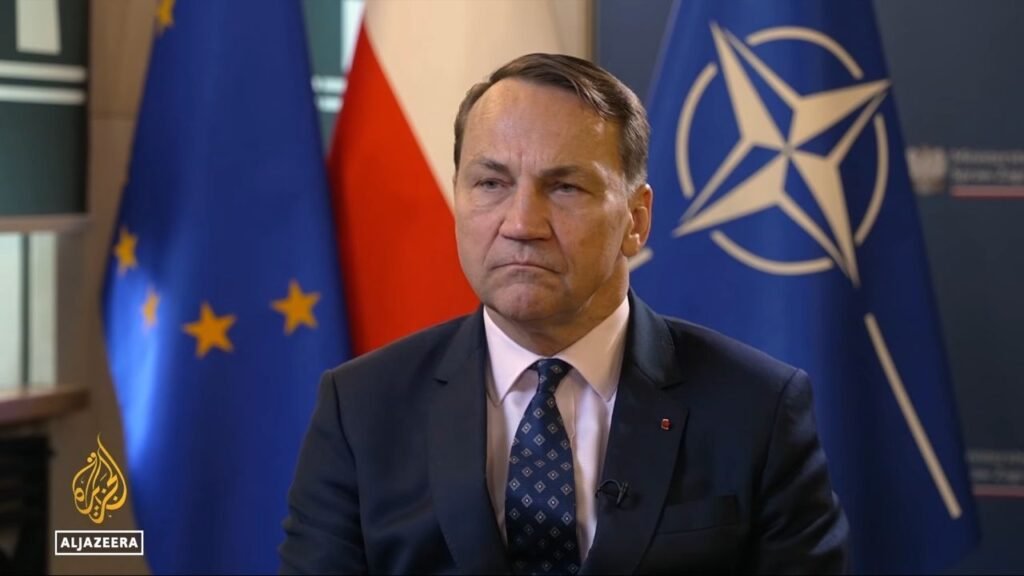
“No, no, wait a second. That’s his problem. He started this war and he will pay the consequences. Russia doesn’t have the right to occupy, to capture Ukraine.”
He emphasized that Ukraine had been a peaceful state and that its constitution provided for neutrality at the time of Russia’s annexation of Crimea.
Sikorski drew a parallel with Iraq’s invasion of Kuwait in 1990, when the international community intervened to oppose the occupation of a smaller country.
“Just because someone is bigger, he or she does not have the right to invade a smaller country,” he stressed.
The Polish diplomat also recalled that Iraqi frozen assets were confiscated following the invasion of Kuwait, while the European Union has struggled to reach an agreement on using frozen Russian assets.
He argued that the situation is complicated by Russia’s veto power in the UN Security Council, which effectively shields Moscow from action by the body responsible for maintaining international peace.
What Sikorski believes is necessary to end the war
The Polish foreign minister believes that the Russia-Ukraine war can end only when Putin recognizes that his original objectives are unattainable.
He emphasized that Russia must abandon the belief that it can determine the future of neighboring states by force, change international borders or decide which nations have the right to independence.
At the same time, Sikorski made clear that Poland would not support peace arrangements that impose territorial concessions on Ukraine.
In his view, Europe’s responsibility is to continue supporting Ukraine so that Ukrainians themselves can determine the conditions under which the war should end.
Leave a comment