
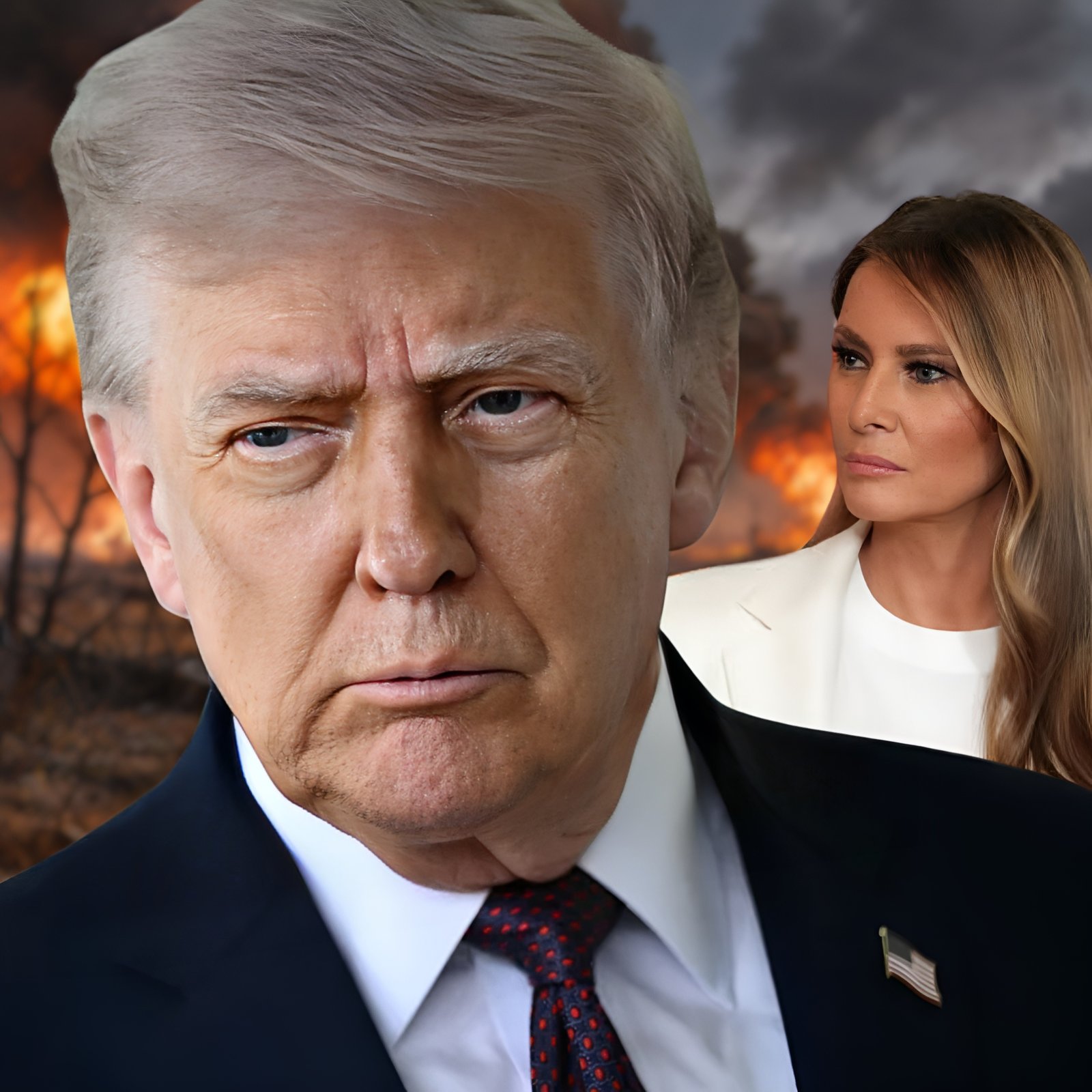
While U.S. President Donald Trump continues to promise an end to Russia’s war against Ukraine, his wife Melania is taking steps that could ultimately prove more consequential than political declarations. A humanitarian operation in the Russian-occupied town of Oleshky has demonstrated that practical cooperation between Ukraine and Russia is possible with American mediation. And perhaps it is precisely such small steps that could pave the way toward a broader peace.
Two Trumps, two approaches to the war
Donald Trump has repeatedly promised to end Russia’s war against Ukraine. His declarations about an imminent peace agreement have become a familiar feature of American political discourse. Deadlines shift, new negotiating formats emerge, and envoys travel between Moscow and Kyiv. Yet the fundamental reality remains unchanged: Russia continues its war, and Ukraine continues to defend itself.
The American president has placed his hopes in major agreements, personal contacts with Vladimir Putin, and political pressure. His diplomatic approach is frequently accompanied by bold predictions that do not always translate into tangible results.
Meanwhile, a different and far less publicized diplomatic effort has gradually emerged from the White House. Its most prominent figure is First Lady Melania Trump.
Unlike her husband, she does not promise to stop the fighting within days or present herself as the principal peacemaker. Instead, she has focused on humanitarian issues, particularly the fate of Ukrainian children and civilians affected by the war.
And this approach may prove unexpectedly promising.
Oleshky: A small ceasefire with potentially major implications
In late October, something relatively rare happened during Russia’s full-scale invasion: Ukraine and Russia agreed to temporarily suspend hostilities in a specific area of the front.
Melania Trump played a central role in facilitating the agreement concerning the Russian-occupied town of Oleshky in Ukraine’s Kherson region.
According to the White House, her team communicated directly with Ukrainian and Russian representatives, coordinating humanitarian objectives, safe routes, and operational procedures.
The ceasefire lasted from October 27 to November 1. During that period, humanitarian supplies were delivered, essential roads were cleared of mines, and nearly 800 people were evacuated.
Crucially, both sides confirmed that the arrangements had been respected.
At first glance, this was a localized humanitarian operation that did not fundamentally alter the battlefield situation. But its political significance could be considerably greater.
For the first time in a considerable period, the two sides not only agreed to suspend fighting but also demonstrated that they could implement a specific agreement under international mediation.
That practical ability to cooperate is precisely what broader peace negotiations have been lacking.
From rescuing children to diplomacy
Oleshky was not Melania Trump’s first humanitarian initiative.
Before the operation, the first lady had already been involved in efforts to reunite Ukrainian children separated from their families because of the war.
According to the White House, the communication channel established through these efforts helped facilitate six family reunification operations involving 34 children.
Those same contacts were subsequently used to organize the humanitarian mission in Oleshky.
This is an important detail.
What began as negotiations concerning individual children and families gradually developed into a mechanism capable of securing a temporary ceasefire.
Support the authors
of Ukraine Brief
→
In other words, Melania Trump’s team has progressed from negotiating the fate of individual civilians to facilitating agreements requiring coordination between the military and civilian authorities of two countries at war.
The question now is whether this experience can be expanded.
A White House meeting: Diplomacy beyond traditional channels
On November 5, Melania Trump hosted representatives of Ukraine and Russia at the White House.
Ukraine was represented by Human Rights Commissioner Dmytro Lubinets and David Arakhamia, head of the ruling Servant of the People parliamentary faction.
The Russian delegation included Yana Lantratova and Kremlin special envoy Kirill Dmitriev.
During the meeting, Lubinets presented the first lady with the Order of Princess Olga, an honor previously awarded to her by Ukrainian President Volodymyr Zelensky in recognition of her humanitarian work.
The meeting itself deserves attention.
While high-level political negotiations remain entangled in disputes over territory, security guarantees, and the conditions for ending the war, humanitarian diplomacy allows the parties to negotiate specific, achievable objectives.
Instead of debating an abstract peace plan, they can work toward results that are measurable and verifiable.
Another detail is particularly revealing.
According to the Associated Press, Donald Trump met with Kirill Dmitriev that day but did not hold a comparable meeting with the Ukrainian representatives.
Melania, meanwhile, received representatives from both countries as part of her humanitarian initiative.
This does not mean that the first lady has assumed the president’s diplomatic responsibilities. But she has already become a distinct and increasingly visible participant in efforts related to the war.
Oleshky as a rehearsal for a broader ceasefire
Perhaps the most significant aspect of the Oleshky operation was not simply the evacuation itself, but the mechanism used to make it possible.
Speaking to reporters in Washington on November 6, David Arakhamia explained that the operation had provided an opportunity to test certain ceasefire-monitoring principles previously discussed during trilateral negotiations.
These included the use of drones to observe the area and identify potential violations.
Dmytro Lubinets also emphasized that the operation had established a mechanism for negotiations, monitoring, and verification of compliance.
This is where a humanitarian mission begins to acquire strategic importance.
Any future ceasefire between Ukraine and Russia will require answers to several fundamental questions: Who will monitor compliance? How will violations be documented? And how will disputes between the parties be resolved?
Some of these procedures have now been tested under real-world conditions in Oleshky.
Of course, suspending hostilities around a single town for six days is very different from maintaining a sustainable ceasefire along the entire front line.
But Oleshky demonstrated that practical ceasefire-monitoring mechanisms can work when the political will exists to implement them.
That may also be an uncomfortable conclusion for the Kremlin, as the operation weakens arguments that a ceasefire would be impossible to monitor.
Why humanitarian diplomacy may succeed where political negotiations have stalled
Major peace negotiations face a fundamental obstacle: Ukraine and Russia disagree not only about the terms of ending the war, but also about what a future peace should look like.
Kyiv insists on security guarantees and the preservation of its sovereignty. Moscow continues to make territorial demands while using military pressure as a negotiating instrument.
Humanitarian issues, however, offer more room for agreement.
The return of children, civilian evacuations, prisoner exchanges, and humanitarian deliveries do not require every political dispute to be resolved beforehand.
That is why humanitarian contacts can gradually establish a practice of cooperation even between countries that remain at war.
Following the Oleshky operation, the Ukrainian and Russian human rights commissioners proposed that Melania Trump help extend similar missions to other communities.
If such operations become regular, they could establish a permanent channel of communication that does not depend entirely on the success or failure of high-level political negotiations.
Still, this process should not be romanticized.
Russia could use humanitarian initiatives to improve its international image without making meaningful changes to its military strategy.
Analysts interviewed by Deutsche Welle have also warned that the success in Oleshky does not necessarily indicate Moscow’s willingness to agree to a broader ceasefire.
The most important measure of Melania Trump’s success, therefore, should not be the number of meetings held or positive statements issued, but the number of lives saved and agreements actually implemented.
Could Melania achieve what Donald has not?
It would be premature to suggest that Melania Trump could end the war on her own.
She does not determine U.S. foreign policy, direct American diplomacy, or make decisions about military assistance to Ukraine.
But she possesses a different kind of influence: direct access to the U.S. president, international recognition, and the ability to maintain humanitarian communication without having to immediately resolve the most difficult political questions.
Her involvement also allows the White House to pursue a parallel diplomatic channel capable of producing results even when the main negotiations are deadlocked.
And this creates a striking political paradox.
Donald Trump wants to be remembered as the president who ended Europe’s largest war since World War II. For him, a peace agreement would represent a potentially enormous political victory.
Melania began with a more modest objective: helping people trapped by the war.
Yet her initiative has already produced measurable results — a six-day localized ceasefire, humanitarian assistance, and the evacuation of hundreds of civilians.
Ultimately, peace does not necessarily begin with the signing of a grand agreement in front of television cameras.
Sometimes it begins with an agreement to stop shooting for a few days so that civilians can escape a dangerous area.
From six days of silence to lasting peace
Following the mission, Melania Trump expressed hope that the experience in Oleshky could become a foundation for lasting peace between Ukraine and Russia.
For now, that remains an aspiration rather than a comprehensive peace plan.
Nevertheless, a possible next step is already emerging: expanding humanitarian missions, establishing a permanent mechanism for cooperation, and applying the procedures developed during these operations to future ceasefire arrangements.
If this process continues, Melania Trump’s role could extend far beyond the traditional responsibilities of an American first lady.
She may never become the principal negotiator between Kyiv and Moscow. But she could become the person who helped establish one of the practical mechanisms necessary for a future peace.
And history might ultimately deliver an unexpected irony.
Donald Trump may spend years talking about how he tried to end the war.
Yet the beginning of a genuine diplomatic breakthrough might one day be traced back to a humanitarian mission organized by his wife.
A Trump may indeed help bring the war in Ukraine to an end. But perhaps the decisive step will not come from Donald at all.

Leave a comment