
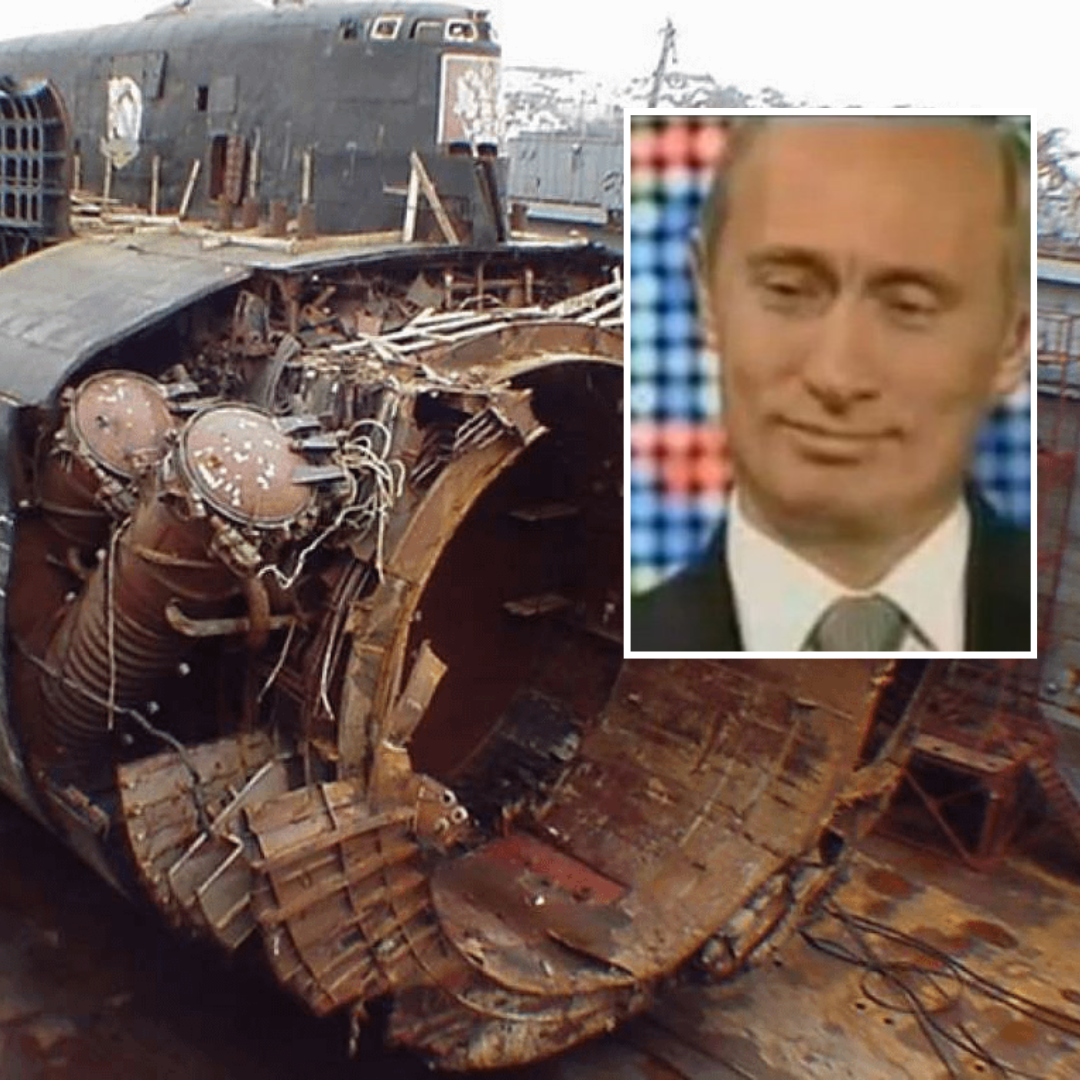
The remains of the Kursk in a floating dock in Roslyakovo (Photo/Wikipedia)
The most infamous episode came after the disaster.
In September 2000, Putin appeared on CNN’s Larry King Live.
King asked a simple question: what happened to the Russian submarine?
Putin replied:
“She sank.”
In Russian: “Она утонула” — “Ona utonula.”
It was not so much the words themselves that caused outrage, but Putin’s delivery and the slight smile that accompanied his answer.
After the deaths of 118 sailors, many saw the response as remarkably cold and cynical.
Those two words became one of the most recognizable quotations of Putin’s early presidency. For his critics, they came to symbolize the distance between the Russian state and the people whose lives it was supposed to protect.
The Kursk and Putin’s Conflict With Independent Media
The disaster also had an important political dimension.
Russia’s media landscape in 2000 was very different from what it is today. Major television networks could still openly criticize the Kremlin, show angry relatives of the dead and ask the government uncomfortable questions.
Coverage of the Kursk became a serious problem for the new president.
Putin publicly clashed with the media over their reporting on the disaster. Over the following years, the Kremlin gradually established control over Russia’s key nationwide television networks.
For this reason, the Kursk is often remembered in the broader context of Russia’s political transformation. The crisis demonstrated to the Kremlin just how dangerous independent television could be when the government could not determine what the public was allowed to see.
Russian journalists would have fewer and fewer opportunities to operate independently in the years that followed.
An Early Warning of What Russia Would Become
In 2000, the West still knew relatively little about Russia’s new president. Putin was largely viewed as Boris Yeltsin’s little-known successor, and the country’s future direction remained uncertain.
Twenty-six years later, the Kursk disaster looks different.
The state’s response to the tragedy already displayed patterns that would become increasingly familiar: secrecy surrounding military failures, reluctance to admit mistakes, contradictory official information, suspicion of the West, and hostility toward independent media.
Of course, a single disaster did not determine Russia’s future. It would also be misleading to judge every Kremlin decision in 2000 solely through the lens of what Putin’s system would become decades later.
But the Kursk was the new president’s first major test.
One hundred and eighteen people died at the bottom of the Barents Sea. Some survived the initial explosions and waited for help.
Weeks later, Russia’s president explained what had happened to an American audience in two words:
“She sank.”
More than a quarter of a century later, the phrase remains more than a reminder of one of the worst disasters in the history of the Russian Navy.
For Putin’s critics, it became one of the earliest symbols of an era that was only just beginning.

Leave a comment