
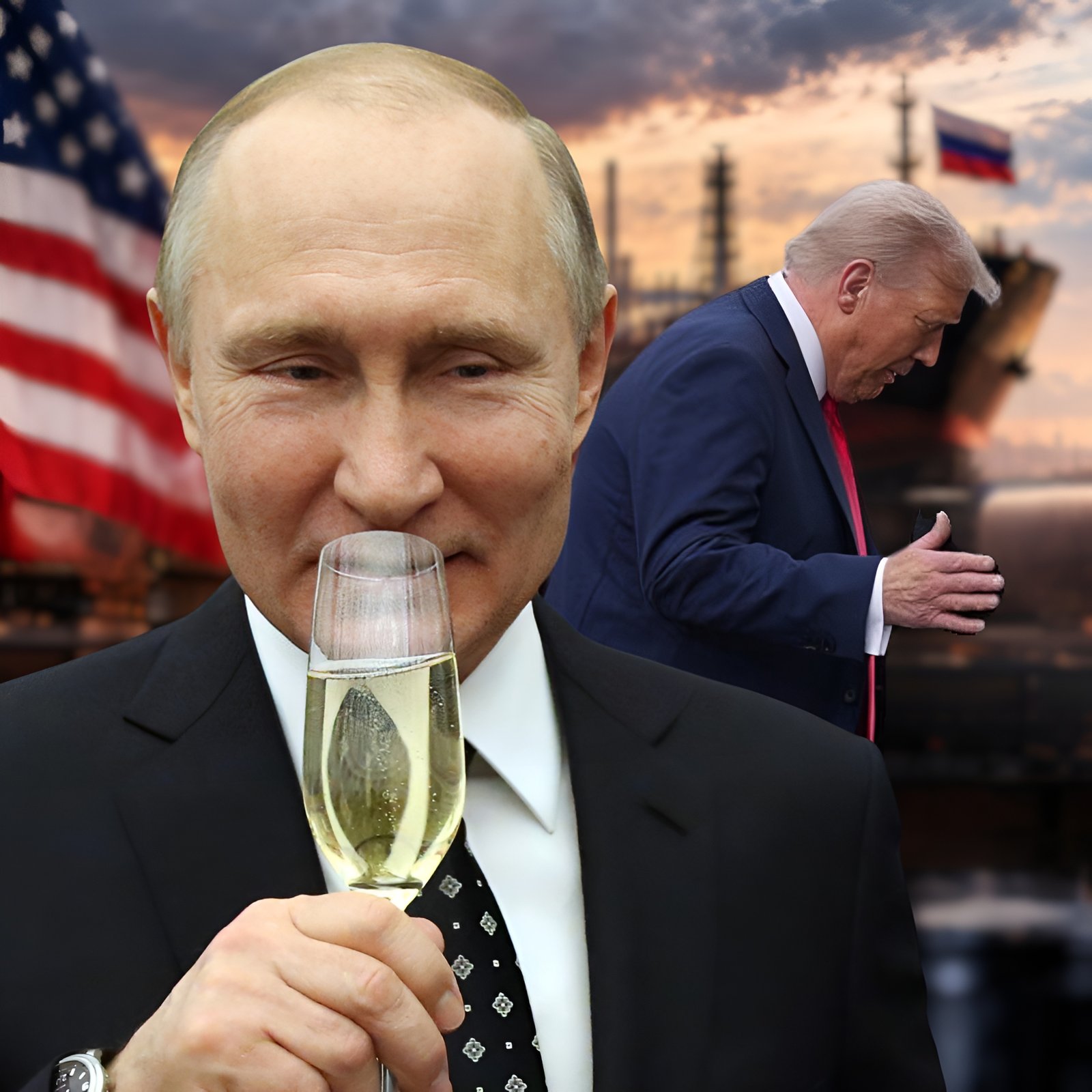
The Russian diesel deal between Donald Trump and Vladimir Putin has raised serious questions about Washington’s sanctions policy and the future of peace negotiations over Ukraine. While Trump celebrates an agreement to bring millions of tons of Russian diesel onto global markets, the Kremlin has secured sanctions relief without committing to end its war. Did Putin manage to turn America’s demand for cheaper fuel into a diplomatic advantage?
MILLIONS OF TONS OF DIESEL IN EXCHANGE FOR SANCTIONS RELIEF
On October 9, US President Donald Trump announced an agreement with Vladimir Putin involving supplies of Russian diesel fuel to American and international markets.
According to Trump, Russia agreed to immediately provide more than 300,000 tons of diesel, followed by another 500,000 tons in November and one million tons shortly afterward. An additional three million tons were also discussed, although their delivery would depend on the condition of Russian oil refineries.
In total, the potential volume of the agreement amounts to approximately 4.8 million tons.
Almost immediately after the announcement, the US Treasury Department issued General License No. 135, authorizing certain transactions involving the sale, transportation, unloading, and importation of Russian-origin diesel fuel, including into the United States. The authorization remains valid until April 7, 2027.
This is not a complete lifting of sanctions on Russia’s energy sector, but rather a specific and politically significant relaxation of restrictions.
And this is where the central contradiction emerges. Washington has already made a decision that opens international markets to Russian fuel. In return, the promised volumes of diesel remain just that — promises.
DIESEL THAT MAY NOT EXIST
Perhaps the most paradoxical aspect of the agreement is that Russia is promising to export millions of tons of diesel at a time when its own oil refining industry is under considerable pressure.
Ukrainian strikes on Russian refineries have already affected the country’s production capacity. According to the Associated Press and other international media outlets, Russia has been forced to restrict diesel exports because of difficulties supplying its domestic market.
According to International Energy Agency figures cited by The Washington Post, Russian diesel production has fallen by approximately 30%.
This raises an obvious question: where will the Kremlin find millions of additional tons of fuel when its refining capacity has already suffered significant damage?
In theory, Moscow could redirect supplies previously intended for other buyers, draw on existing inventories, or gradually increase production. But none of these options automatically guarantees additional diesel supplies for the global market.
Moreover, Trump’s own announcement explicitly linked the delivery of the final three million tons to the condition of Russian refineries.
In other words, the US president effectively acknowledged the existence of production constraints while simultaneously presenting the agreement as a major economic achievement.
PUTIN GETS ECONOMIC RELIEF WITHOUT ENDING THE WAR
For the Kremlin, the agreement carries significance far beyond the fuel trade.
Since the beginning of Russia’s full-scale invasion of Ukraine, Western sanctions have sought, among other objectives, to restrict Moscow’s energy revenues. The underlying strategy has been to reduce Russia’s financial capacity to sustain its aggression.
Now the United States, which previously intensified economic pressure on the Kremlin, is opening a specific channel for trade in Russian petroleum products.
Yet Russia has not announced a ceasefire, agreed to withdraw its forces from occupied Ukrainian territories, or demonstrated any publicly confirmed concessions in the peace process in exchange for the diesel agreement.
On the contrary, according to Reuters, Putin continued to insist on Russia’s conditions for ending the war during his conversation with Trump.
Moscow has therefore gained an opportunity to ease certain economic restrictions without any obvious change in its position toward Ukraine.
For the Kremlin, this is also a diplomatic signal: even amid an ongoing war and international sanctions, Washington remains willing to negotiate economic cooperation directly with Russia.
WHY TRUMP AGREED TO THE DEAL
The American president’s decision also has a domestic political explanation.
The United States has been facing high diesel prices, affecting not only motorists but also transportation costs, agricultural production, and the prices of many consumer goods.
With the US midterm congressional elections approaching, the Trump administration has a strong interest in bringing energy prices down quickly.
According to the Associated Press, average diesel prices in the United States exceeded six dollars per gallon. Under these circumstances, announcing millions of tons of additional fuel supplies could be politically attractive.
Markets did react to Trump’s announcement. According to S&P Global, a key measure of diesel refining margins fell significantly following news of the agreement.
However, a financial market reaction to an announcement and an actual reduction in fuel prices for American consumers are two different things.
If Russia simply redirects existing diesel supplies from one group of buyers to another, the total global supply may remain largely unchanged.
In that case, the political impact of the agreement could prove considerably greater than its economic benefits.
UKRAINE WILL CONTINUE STRIKING RUSSIAN REFINERIES
Another factor casting doubt on the agreement’s prospects is Ukraine’s position.
Kyiv has no intention of abandoning strikes against Russian oil refining infrastructure simply because Washington has reached a diesel supply agreement with Moscow.
As reported by the Financial Times, citing a senior Ukrainian official, Ukraine intends to continue attacking Russian refineries.
“We will burn their refineries,” the official declared.
This creates an additional problem for Trump. Even if the Kremlin genuinely intends to fulfill its commitments, Russian refining capacity will remain vulnerable to Ukrainian military operations.
The American administration is therefore counting on stable deliveries from a country whose fuel industry continues to suffer wartime damage.
Ukrainian President Volodymyr Zelenskyy described the US decision as weak and warned that allowing Russia to sell petroleum products effectively provides additional resources to continue the war.
Zelenskyy also emphasized that economic concessions to the Kremlin do not bring peace closer if Moscow refuses to change its aggressive policies.
PEACE TALKS AND THE DIESEL DEAL: TWO CONTRADICTORY SIGNALS
The timing of the announcement deserves particular attention.
On October 9, representatives of Ukraine, the United States, and European countries were holding talks in Miami, seeking to coordinate a common approach to ending Russia’s war against Ukraine.
At the same time, Trump was negotiating energy cooperation with Putin.
According to Reuters, the Kremlin described the conversation between the two presidents as friendly and substantive. Putin’s aide Yuri Ushakov even claimed that neither leader wanted to be the first to end the call.
Yet this diplomatic warmth was not accompanied by reports of any meaningful breakthrough toward ending the war.
The result is a contradictory situation: Washington is trying to persuade Moscow to accept peace while simultaneously easing part of the economic pressure that could otherwise be used as leverage in negotiations.
This does not necessarily mean that the United States is abandoning its support for Ukraine. However, such a move could undermine the credibility of future sanctions threats.
If the Kremlin sees that economic concessions are possible without ending hostilities, it may have fewer incentives to change its negotiating position.
WHO IS REALLY TAKING THE BIGGER RISK?
From an economic perspective, the agreement offers potential benefits to both sides.
The United States hopes to increase available diesel supplies and lower prices. Russia seeks broader export opportunities and additional revenue from petroleum products.
But the nature of the risks is different.
For Trump, it is essential that the promised fuel actually reaches the market and contributes to a noticeable decline in prices. Otherwise, the widely promoted diplomatic achievement may fail to deliver the expected results for American consumers.
For Putin, the sanctions relief itself already carries political significance. However, the actual financial benefits for Russia will depend on how much fuel is sold, at what prices, and whether the transactions are completed.
So far, there are no publicly confirmed figures showing actual deliveries under the new agreement. Nor is there sufficient evidence to claim that Russia has already received billions of additional dollars specifically because of this decision.
The political consequences of the agreement have therefore begun to emerge, while its economic results remain uncertain.
A “DEAL WITH THE DEVIL” OR A PRAGMATIC CALCULATION?
Supporters of the agreement may view it as a pragmatic decision: at a time of high fuel prices, the American administration is using available opportunities to stabilize energy markets.
This argument cannot simply be dismissed. Cheaper diesel could genuinely reduce costs for American businesses and consumers.
Critics, however, point to another side of the decision: in pursuit of a potential short-term economic benefit, Washington is easing sanctions against a country that continues to wage a full-scale war.
Furthermore, the economic outcome remains uncertain.
This brings us back to the central question: Has Putin exploited Trump’s need for cheaper fuel to secure concessions without making any corresponding political commitments?
The publicly available evidence does not prove that the Kremlin deliberately deceived the American president. However, it does reveal a significant imbalance between the sanctions relief already granted by Washington and the Russian promises that have yet to be fulfilled.
THIS IS ABOUT MORE THAN DIESEL
The Russian diesel controversy is not simply a dispute over fuel prices. It illustrates the difficulty of reconciling US economic interests with a policy aimed at containing Russia.
Trump wants to demonstrate to Americans that he can negotiate even with Washington’s adversaries and deliver tangible economic results.
Putin is seeking to restore Russia’s trading opportunities, reduce sanctions pressure, and maintain his demands regarding Ukraine.
Whether the agreement becomes a genuine success for the American economy will depend on actual deliveries and future fuel prices.
But for Ukraine, the fundamental question is different: will this agreement help bring the war to an end, or will it merely weaken one of the instruments of pressure on the Kremlin?
For now, the most striking contradiction is that sanctions relief has already become a reality, while the promised millions of tons of diesel — and any Russian concessions toward peace — have not.
That is precisely why Trump’s agreement with Putin deserves far more scrutiny than an ordinary commercial deal.


Leave a comment